





I recently discovered a book containing one of the most remarkable descriptive passages I've ever read. Imagine you’re a worker in the North Tower of the World Trade Center in New York on 9/11. Your work location was on the 64th floor. The 767 jet had already crashed into the building between the 93rd and 99th floors.
You’re a structural engineer and you’re evacuating. And I’ll let the author take it from here:
“(Pasquale) Buzzelli had just passed the 22nd floor when the North Tower gave way,” William Langewiesche writes in American Ground: Unbuilding the World Trade Center. “It was 10:28 in the morning, an hour and 42 minutes after the attack. Buzzelli felt the building rumble, and immediately afterward heard a tremendous pounding coming at him from above, as one after another the upper floors collapsed in sequence. Buzzelli’s memory of it afterward was distinct. The pounding was rhythmic, and it intensified fast, as if a monster boulder were bounding down the stairwell toward his head.”
Wow! We’ve all seen what the collapse looked like from the ground and TV helicopters. And here you have a real description of what it was like to be inside a WTC tower when it collapsed.
“He reacted viscerally by diving halfway down a flight of stairs and curling into the corner of a landing. He knew that the building was failing. Buzzelli was Catholic. He closed his eyes and prayed for his wife and unborn child. He prayed for a quick death. Because his eyes were closed, he felt rather than saw the walls crack open around him. For an instant, the walls folded onto his head and arms and he felt pressure, but then the structure disintegrated beneath him, and he thought, ‘I’m going,’ and began to fall.”
You never have a parachute handy when you need one. The author continues:
“He kept his eyes closed. He felt the weightlessness of acceleration. The sensation reminded him of thrill rides he had enjoyed at Great Adventure, in New Jersey. He did not enjoy it now, but did not actively dislike it, either. He did not do anything at all. He felt the wind on his face, and a sandblasting effect against his skin as he tumbled through the clouds of debris. He saw four flashes from small blows to the head, and then another really bright flash when he landed. Right after that, he opened his eyes, and it was three hours later.”
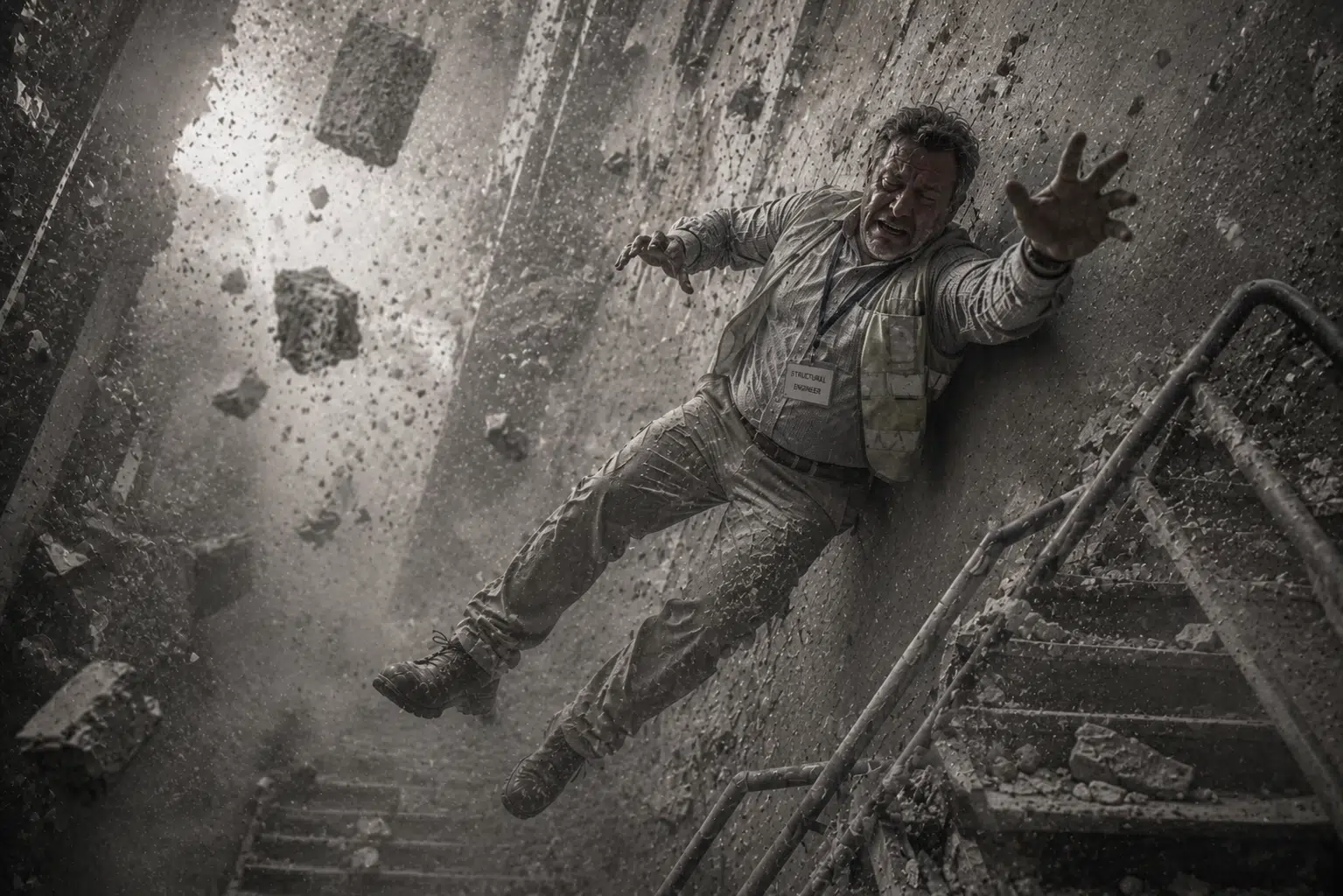
The image above was created with ChatGPT as an attempt to visualize what Buzzelli may have experienced when the collapse reached his floor. Buzzelli survived in the stairwell.
“He sat up. He saw the blue sky and a world of shattered steel and concrete. He had landed on a slab like a sacrificial altar, perched high among the mountains of ruin.”
It’s a great writer who can describe a scene like that, a description that puts the reader into the stairwell with Buzzelli. A fantastic piece of work, Mr. Langewiesche! You can find the book here if you’re interested.
The overall subject is how the tangled, toxic mess was dismantled and cleaned up, including some scenes in the 70-foot-deep basement under the groaning steel and concrete rubble as engineers from the Port Authority of New York and New Jersey examined the retaining walls and the chiller plant. It’s harrowing, real-life reading.