
What you put in your memoir: Scenes from your life.
By- Michael McKown
Mike, go get a job
How I got fired from a gas station job
I was a high school senior in 1964 when I landed my first real job. It was after school at a gas station in Tustin, California. The owner needed someone to fill gas tanks, do lube jobs, oil changes, and so on. He showed me the ropes, then I was pretty much on my own.
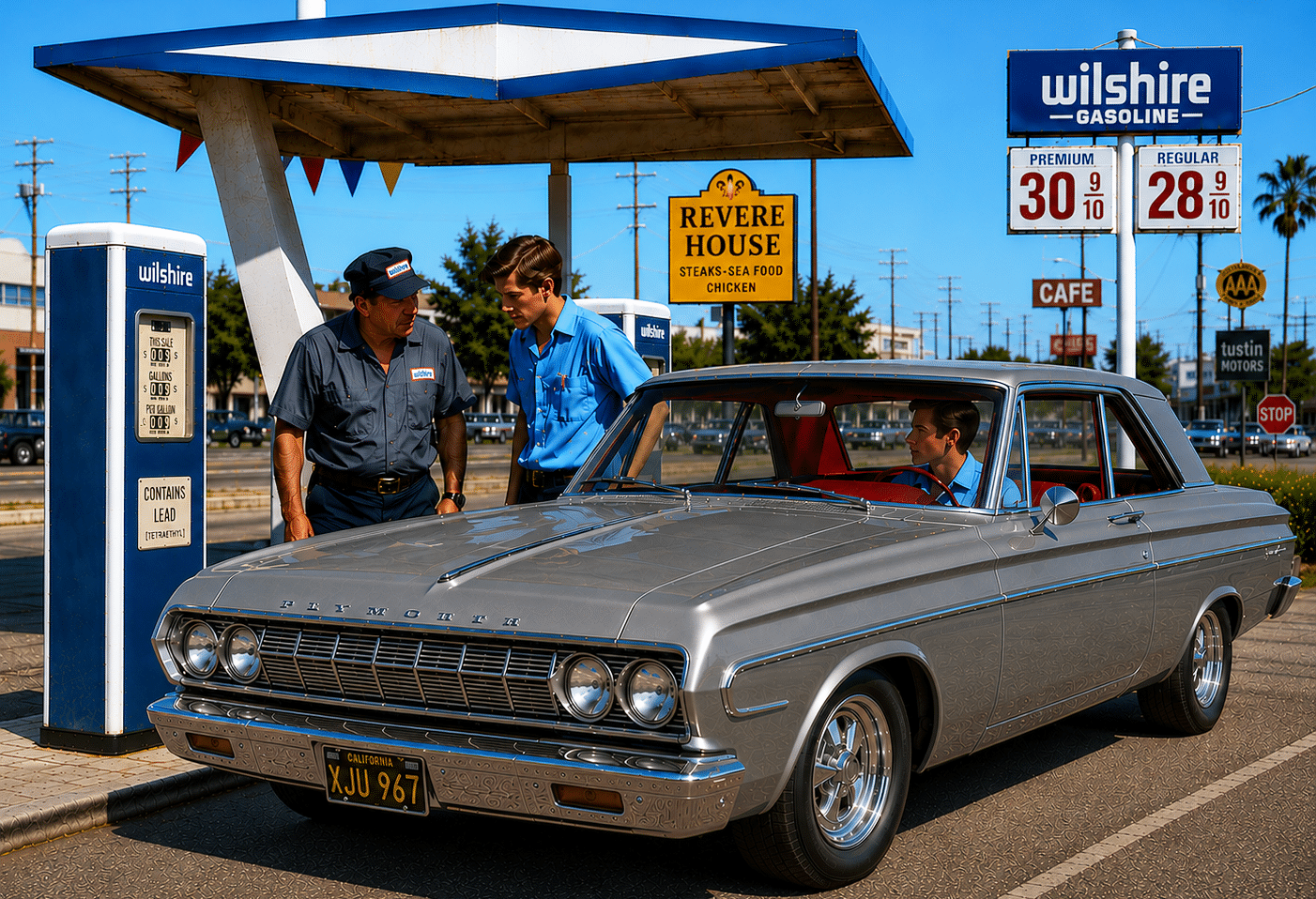
The Wilshire gas station owner teaches the young man how to run the business. The station was located in Tustin, California.
I’d show up for work, and after making sure I knew what needed to be done, the boss would disappear. A daily occurrence. Eventually, I learned where he went. He’d spend the evenings in a neighborhood bar while I ran the station. One time, his wife called. I said he wasn’t here. She demanded to know where he was. I told her which bar he was at.
The next day, I got a royal chewing out for not covering for him. And he fired me. I went home and told mom and dad, with an eyeroll and a laugh. It wasn’t about how well I did my job. I just didn’t know my job was lying to his wife.
The soda fountain cocktail
My next job was at Oscar’s Drive-In Restaurant in Santa Ana. I worked the soda fountain, where I dispensed soft drinks and ice cream. Orders would come in from carhops, all of whom were young ladies. I’d fill the orders and they’d go out with the carhops, who would set them on a side window tray.
On Friday and Saturday evenings, the lot was full, mostly guys just hanging out to see the cars and the carhops. Drag races were often negotiated there. One night, a carhop brought in a glass, half filled. “Mike, a guy put booze in his Coke!” she said as she put it on the counter.
I sniffed. Yep! Booze. Normally, I’d send it off to the dishwasher, but not this time. I chuckled and parked the booze under the counter. I was gonna treat someone later in the evening when the parking lot filled up.
Then it was time to wait until a typical guy order came in, which was: two Cokes. That minimized the risk. Almost certainly, it meant: two guys in a car, placing the minimum order to stay in the lot. A carhop told me: two Cokes. I split the booze, added ice and Coke, and sent ‘em out.
An hour later – some guys sip slowly – a bewildered carhop returned with empty glasses. “The guys in that yellow pickup told me to tell you thanks for the best Cokes they ever had.” I just broke up laughing.
Motivation to do his chores
The filthy swimming pool invitation
Like most kids, I had household chores. The one I hated most was sweeping our swimming pool, and everybody knew it. Every day or two, I was told to sweep dirt to the drain and scoop leaves from the surface. I was probably 14 at the time.
One day, a kid who lived a couple blocks away, invited me over to swim at his house. I got into my trunks, hung a towel around my neck, slipped into flip-flops and headed out. His mom laid out lemonade and snacks before we hit the pool. And then I met the pool.
Yikes! On the bottom of the pool was roofing paper. Several big chunks of dog poop. And a tricycle. I thought, are you kidding me? I feigned not feeling well and said I had to go home. Upon arrival home, I went straight to the back yard, grabbed the long-pole brush and began sweeping the pool. Without being told to.
Mom came out. “What are you doing?” She hadn’t seen me volunteer to do this before. She stared for a moment. “Are you feeling all right?” She got a call from that kid’s mom, who wondered whether I was OK. Then I explained it was just a ruse to get out of there. I told her about the roofing paper, the tricycle and the dog poop, and their expectation that I would enjoy swimming amid it all.
Then I added: “I suddenly wanted to clean our pool.”

Oscar’s Drive-In Restaurant in Santa Ana, California. A carhop on roller skates stops to chat with a guy in a hot Mustang.
Tell the stories that are uniquely you
What memoir readers seek
None of these incidents would have made the evening news. None changed the course of history. But they’re part of my life, and together they’re part of my story.
Some prospective clients wonder whether their life had been interesting enough to deserve telling it in a memoir. Everybody has a story to tell. It’s the culmination of hundreds of experiences, large and small, that together make up a life. That’s what memoir readers want to see. If you’re exploring the idea of turning your experiences into a book, our professional ghostwriting services can help you shape those memories into a compelling manuscript.
You are probably not the best judge of whether your story is worth passing on to others. You’re too close to it. Your stories seem ordinary because, well, because they happened to you, not someone else. Choosing someone who knows how to recognize those memorable moments is important, so here’s how to choose the right ghostwriter for your project.
I’m an avid memoir reader. Two items in my bookcases are worthy of mention because most folks wouldn’t think they were worth publishing. But a couple publishers concluded differently.
Unlikely published titles
First Job
We begin with First Job: A Memoir of Growing Up at Work, by Rinker Buck. A guy fresh out of college lands a job as a cub reporter at a New England newspaper in the 1970s. “Buck’s tale is replete with mentors who guided him through a raw and anxious time, lovers who exposed him to new levels of intimacy; and adventures that could only have happened to a young man who didn’t know any better – including the way he snared an exclusive interview with John Wayne by bringing along a pretty girl who so charmed the Duke that he gave Buck a wonderfully frank and cranky story to write,” says the reviewer at GoodReads.
Who would have guessed that a memoir about someone’s first job would find an audience? But it happened. Why? Because Rink told the stories unique to him.
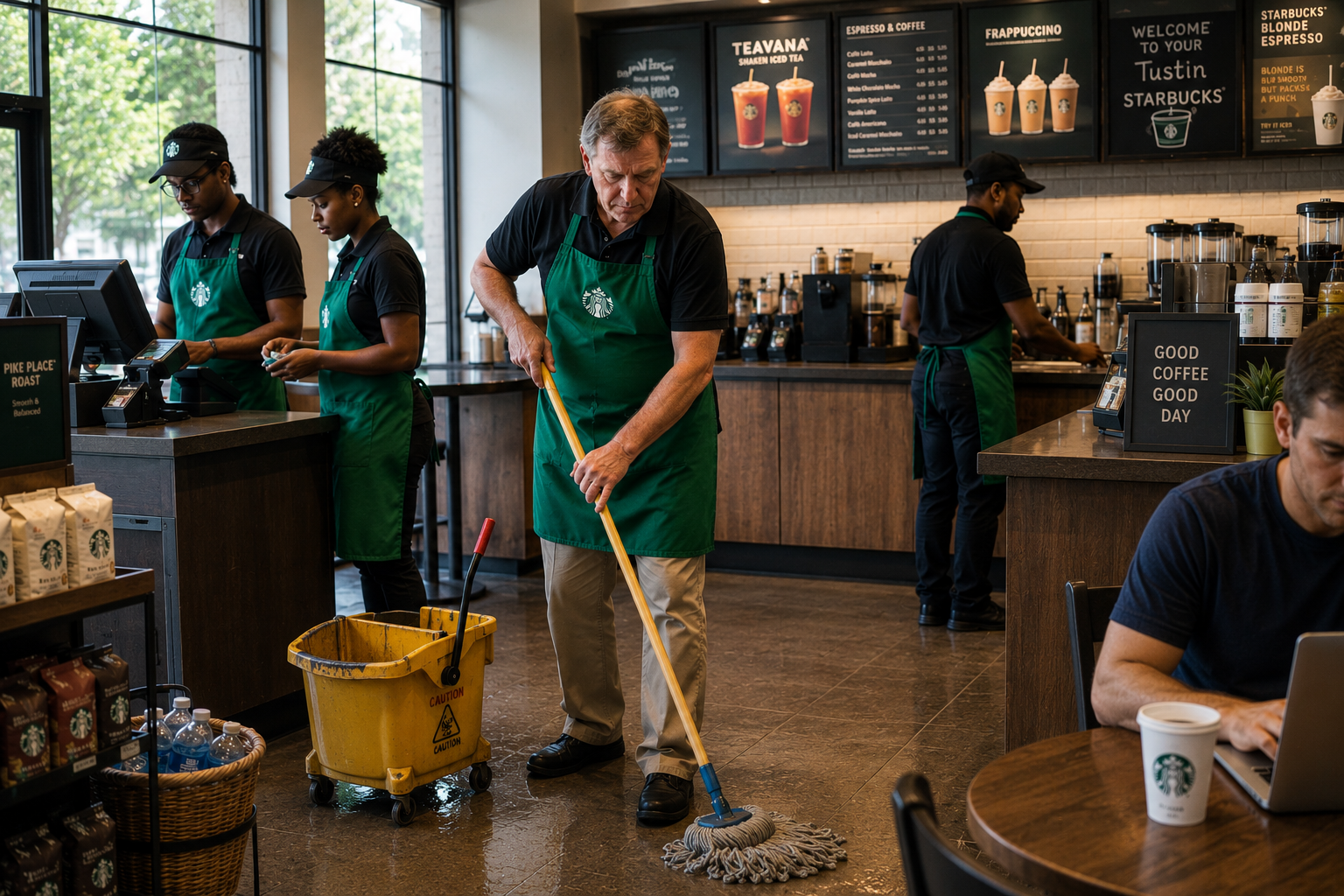
A former advertising executive takes a job at Starbucks to pay the bills, restarting at the bottom.
Scrubbing porcelain at Starbucks
Second, How Starbucks Saved My Life: A Son of Privilege Learns to Live Like Everyone Else, by Michael Gates Gill. I thought that was an odd title to find at Barnes & Noble, but I was curious. I took it home. Gill was a successful New York advertising agency executive with an Ivy League education, a big house, a family, and a salary into six figures. He was let go. His wife filed for divorce. He lost his house. Nobody would hire him. He had fallen down to the sharp, desperate edge.
He was in a Starbucks nursing a latte, wondering how to save himself. That day, the manager was interviewing prospective employees. She slipped him an application, and he decided to go for it. It turned out he was the only white employee in a store operated by African Americans. He started at the bottom, including cleaning toilets.
The GoodReads reviewer said, “Crossing over the Starbucks bar was the beginning of a dramatic transformation that cracked his world wide open. When all of his defenses and the armor of entitlement had been stripped away, a humbler, happier and gentler man remained. One that everyone, especially Michael’s kids, liked a lot better.” And Gill rose up the store ranks. What began as a desperate attempt to pay the bills became an unexpected second act in his life. At age 60.
It’s a story about redemption, hope, and the unexpected kindness of one person who offered a lifeline to someone who never imagined he’d need one.
“Am I interesting enough?”
Memory vs memoir
We don’t remember our lives as timelines, one continuous, chronological day-after-day. A good friend of mine pointed out that we remember our lives as scenes. That’s what your life is, in sum. And with no doubt, you won’t remember most of those scenes until you engage in conversation about your life with an interested someone who wants to write it down. Then your memories will pour forth.
People often wonder whether their lives are interesting enough for a memoir. When I’m on the phone with someone like that, I probe their life. Soon, they’re usually telling me stories they haven’t thought about in decades. A summer job. A military assignment. A family vacation. A disastrous first date. A chance encounter with someone famous. The stories come back because they mattered, even if they didn’t seem important at the time.

A daughter introduces her date to her father, who bears an uncanny resemblance to Dean Wormer from Animal House.
If you’re wondering whether your life is worth writing about, you’re asking the wrong question. The better question is this: Which moments from your life do you still remember after all these years? Those are often the stories your readers will remember, too.
In 2005, a famous Canadian actor died. The Los Angeles Times, the newspaper of record for the film and TV industries, sought out those who knew him for their thoughts. They shared their stories about the man, and among those was someone really close to the deceased. I laughed out loud. And here we go:
When her date met dad
Animal House, the raucous 1978 movie, pitted the miscreant inhabitants of a slovenly fraternity house against the college dean who had reached his limit of tolerance for the teenage outlaws on campus. Dean Wormer was played to chilling effect by the icy-eyed John Vernon.
Now, in real life, Vernon had a teenage daughter who invited her new boyfriend over to meet the parents. When the kid laid eyes on her dad, he froze. Everything the poor guy remembered from Animal House hit him hard. His eyes popped open and his blood temperature dropped 20 degrees. Niceties were exchanged, and then they left on their date. In the car, he turned and said, with a note of terror in his voice: “YOUR FATHER IS DEAN WORMER?!”
If she writes her memoir, that encounter is an absolute must for inclusion.
One way to find out
Make the call
Find out whether your life tale could potentially reach an audience. If you’re wondering exactly what a ghostwriter contributes to the process, this guide explains what ghostwriters do from the first interview through the finished manuscript. A free consultation with a professional ghostwriter is your opportunity to talk about your experiences with someone who’s been a huge fan of personal stories since forever.
Ghostwriters Central has been in the business of telling people’s stories since 2002. We know how to present your life in an engaging way, so when the writing is finished, your memoir is ready for a publisher. The question I’ll ask now is: What are the stories that are uniquely you? If your goal is to preserve your life’s experiences for family, friends, or a wider audience, our memoir ghostwriting services can help transform your memories into a professionally written book. Make the call. Let’s find out.