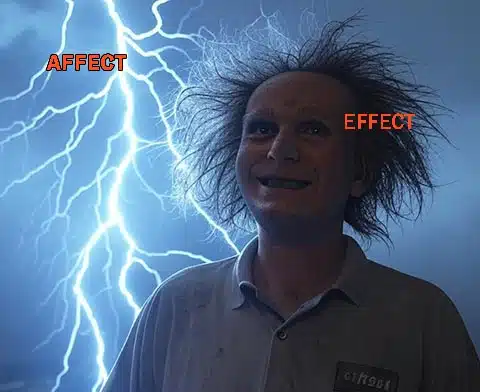
Let’s resolve a headache, the one that has plagued writers since…well, the plague. It is: when to use “affect” versus “effect.” Read More...
![]() |
|
|
It is only natural to pattern yourself after someone. But you can’t just copy someone. If you like someone’s work, the important thing is to be exposed to everything that person has been exposed to.
Do not place a photograph of your favorite author on your desk, especially if the author is one of the famous ones who committed suicide.
Editor: A person employed by a newspaper, whose business it is to separate the wheat from the chaff, and to see that the chaff is printed.
It took me fifteen years to discover I had no talent for writing, but I couldn’t give it up because by that time I was too famous.
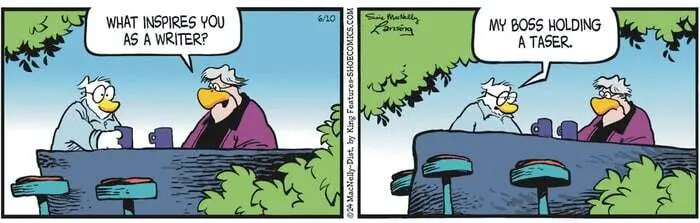
The fact is, I don’t know where my ideas come from. Nor does any writer. The only real answer is to drink way too much coffee and buy yourself a desk that doesn’t collapse when you beat your head against it.
No one can write decently who is distrustful of the reader’s intelligence or whose attitude is patronizing.
If one cannot enjoy reading a book over and over again, there is no use in reading it at all.
Substitute “damn” every time you’re inclined to write “very”; your editor will delete it and the writing will be just as it should be.
A true author, no matter the medium, is an artist with godlike knowledge of his subject, and the proof of his authorship is that his pages smack of authority.
No writer has ever yet been known to hang himself as long as he had another chapter left.
A good novel tells us the truth about its hero; but a bad novel tells us the truth about its author.
The reason 99% of all stories written are not bought by editors is very simple. Editors never buy manuscripts that are left on the closet shelf at home.
I have long felt that any reviewer who expresses rage and loathing for a novel is preposterous. He or she is like a person who has just put on full armor and attacked a hot fudge sundae or banana split.