
Kurt Streeter writes:
”I remember those afternoons — sitting beside her desk, doing homework, listening to the staccato rhythm of her IBM Selectric — the feeling that returns is warmth. Security. The machines she favored were robin’s-egg blue, the keys tapping in a steady pulse that meant she was there.”
He was reminiscing about the late 1970s in Seattle, when he was in middle school. His mom and dad divorced and she worked as a secretary (which today is called an administrative assistant). He said he had been fascinated with those heavy behemoths but barely used them. He wrote his homework in longhand, and a friend keyed them into a word processor.
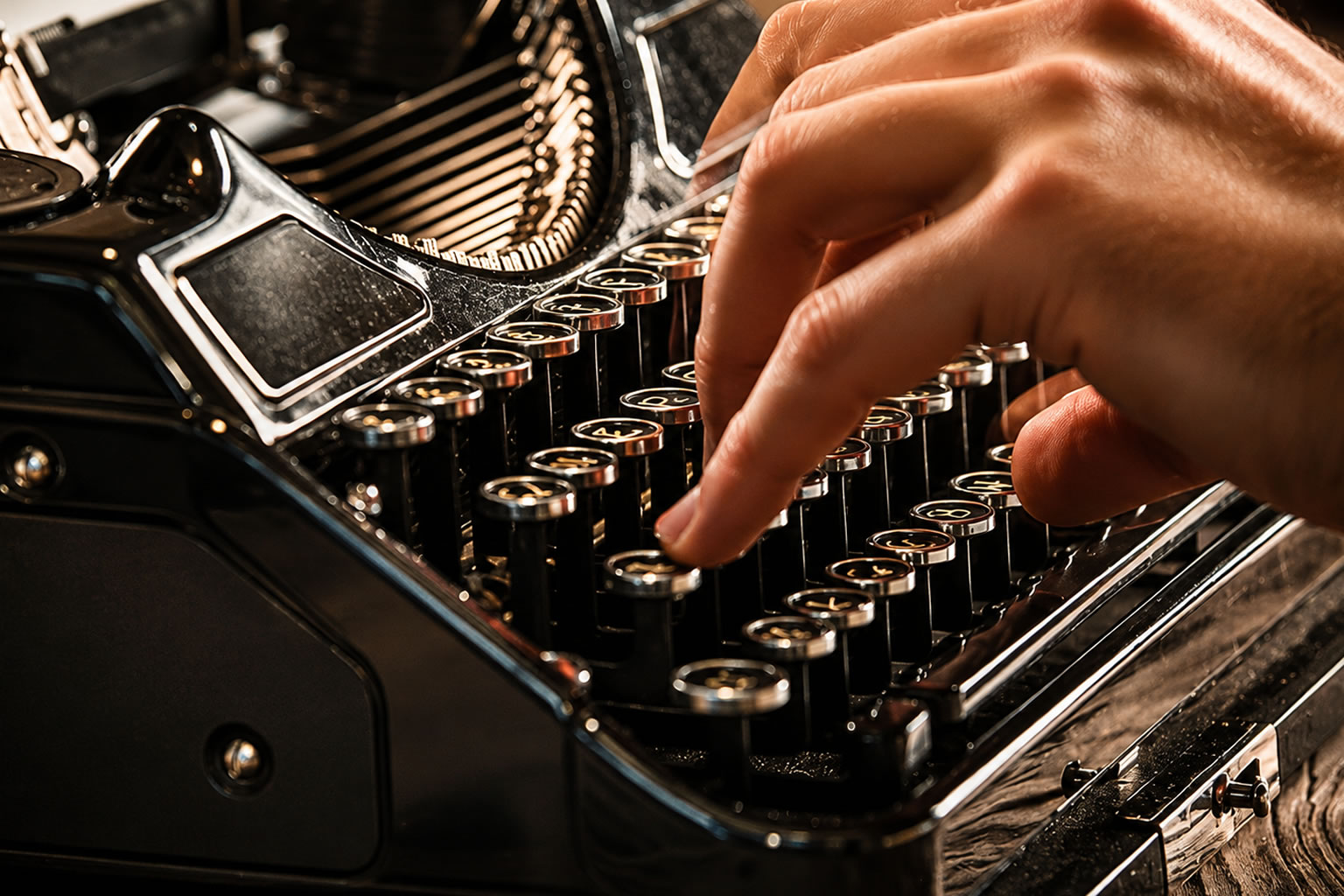
Ernest Hemingway wrote on a typewriter. Tom Hanks does the same, and collects them. I have a Royal HH (1953-1955) on display in my house. I learned to type on one of those.
Streeter now writes for the New York Times. Not long ago, he wondered if anyone was keeping the craft of typewriter maintenance alive. Think of the things for which those machines were used. Manuscripts. Newspaper and magazine copywriting. Radio and television scripts. Theatrical screenplays. Stage play scripts. Letters. Invoices. Literally everything.
I go back that far. In fact, there’s an article on this site about how I won a typewriter in middle school. I recall being dumbfounded the first time I heard “word processor.” My initial reaction was: How does one “process” words?
Streeter’s curiosity about the few remaining typewriter repair technicians led him to Bremerton, WA, where one Paul Lundy had a shop. He said Lundy had machines in the windows. Passersby quit passing. They gazed at the old machines. They came in and Lundy invited them to sit and type.
As anyone unaccustomed to a typewriter would discover, mistakes can’t be deleted. When you grew up with them, you learned to type accurately, or your work would be error-filled. Streeter quickly found that out. His work had lots of words X’d out. But his fascination was not affected. He described the machines as beautiful and remarkably well engineered.
You can visit the NY Times website and read his sentimental article. Mr. & Mrs. Vintage Typewriters offers fully-reconditioned vintage typewriters for sale, if you’re curious.
There’s a difference between writing on a typewriter and writing on a screen.
On a typewriter, mistakes stay, or with difficulty, get corrected. You either fix them or live with them. Over time, that forces a certain kind of discipline. It’s almost steampunk with its intricacy, beauty and ingenious engineering. The only things missing are valves and a pressure gauge.
Nobody would regard a computer as steampunk. That’s not how most writing works today. Everything can be deleted on a soulless computer. Rewritten. Replaced. The tools keep improving. The process gets faster.
From writing longhand to writing on heavy, clunky, mechanical typewriter. To writing on a computer, a device so bland and devoid of personality that it’s like an appliance. Who knows? Maybe one day thoughts will result in text, without any need to involve fingers. No craftsmanship at all. That would be sad.