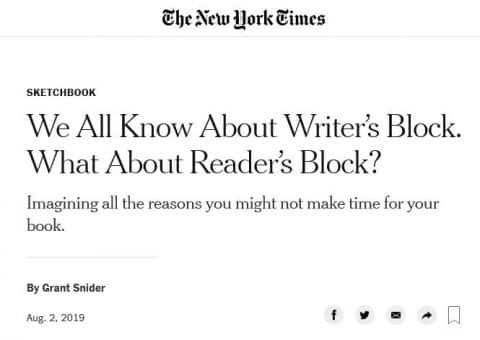
I found this in the August 2nd, 2019, New York Times. Fun reading…if you’re not suffering from reader’s block: Read More...
I found this in the August 2nd, 2019, New York Times. Fun reading...if you're not suffering from reader's block:
Reader's block article
My own experience is that once a story has been written, one has to cross out the beginning and the end. It is there that we authors do most of our lying.
Do you know what a playwright is? A playwright is someone who lets his guts hang out on the stage.
When writing a novel, that’s pretty much entirely what life turns into: “House burned down. Car stolen. Cat exploded. Did 1,500 easy words, so all in all it was a pretty good day.”
If the sex scene doesn’t make you want to do it — whatever it is they’re doing — it hasn’t been written right.
Editor: A person employed by a newspaper, whose business it is to separate the wheat from the chaff, and to see that the chaff is printed.
A good novel tells us the truth about its hero; but a bad novel tells us the truth about its author.
In Hollywood, the woods are full of people that learned to write but evidently can’t read. If they could read their stuff, they’d stop writing.
No one can write decently who is distrustful of the reader’s intelligence or whose attitude is patronizing.
I write the last line, and then I write the line before that. I find myself writing backwards for a while, until I have a solid sense of how that ending sounds and feels. You have to know what your voice sounds like at the end of the story, because it tells you how to sound when you begin.
It is only natural to pattern yourself after someone. But you can’t just copy someone. If you like someone’s work, the important thing is to be exposed to everything that person has been exposed to.
If one cannot enjoy reading a book over and over again, there is no use in reading it at all.