











In the mid-1980s, the publishing world was quietly undergoing a revolution. For nearly a century, producing a magazine page required typesetters, paste-up artists, and expensive machinery run by specialists. Then along came the Macintosh and something called desktop publishing.
At the time this was developing, I ran a working dog magazine, complete with all the manual paste-up, and other production headaches. Typesetting was done with an IBM Selectric Composer, which was cumbersome, slow, and a maintenance nightmare. My office staff and I became well acquainted with the IBM repair technician.
In 1984, Apple Computer introduced the Macintosh with a Super Bowl commercial that shook the world. Not long after, desktop publishing became a thing. You could create a page on the Mac and output it to a 300-dpi laser printer, and suddenly you had high-quality output ready for a newsletter or magazine.
I realized this could dramatically improve throughput for my magazine. I was living in Benicia, California, at the time, which is located in the northeast part of San Francisco Bay. My office was in a concrete building at the Arsenal. It housed heavy machinery during World War II, and was later converted to artist studios. Each unit had tall windows, a nice view of the Carquinez Strait, and funky, scarred, fluid-spill-marked and burned (!) plank floors.
In around 1985, a computer and printer expo was coming to a convention center in San Francisco. I wanted to go, thinking it could be a productive visit. Macintoshes were everywhere, hooked up to various kinds of printers. Mergenthaler Linotype was present with its new line of laser imagesetters. The demo: A guy draws designs and text on a Mac then outputs it to roughly 1,270-dpi resolution on photosensitive white paper. You then run the paper through developer and out comes a professional-level image, with text embedded.
Wow! I thought it would be nice to tell IBM to come pick up that piece-of-junk composer.
While there, I met a guy who was using an early IBM PC for image generation. He invited me to drop by his Silicon Valley office for a personal demonstration. A few days later, I called for an appointment and hit the road. He led me into an equipment room. An IBM PC AT (which meant: Advanced Technology) was hooked up to a printer. I asked him to work up a design and output it.
It was amusing watching this command-line computer trying to draw an image. It took several minutes to generate a simple box. I thought, are you kidding me? I thanked him for the attempt, and headed home. I called the Linotype rep and ordered a Linotronic 100 Imagesetter and two Macs. They gave me a date by which to expect delivery. Meanwhile, I took care of the financing package. Total cost was around $35,000.
Desktop publishing did to typesetting what word processors did to typewriters. It changed the economics of publishing almost overnight.
The delivery date came and went. Repeated calls to Linotype made me wonder if they knew what they were doing. Finally, I demanded that they deliver the damned things or I’d cancel the order. Shortly afterward, it arrived. At a later expo, I met the Linotype CEO. I told him about my little adventure with the order. He said he remembered that, and when he looked into it, he discovered his subordinates were trying to hide the order debacle from him.
No problem. Stuff happens.
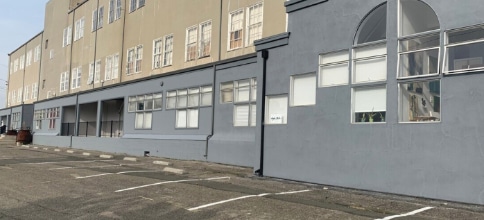
Wine Country magazine was housed in the gray building; my office was in the two-story building behind.
Productivity soared. Wine Country magazine’s office was below mine at the Arsenal. They had been using photo typesetting systems. I invited the owner upstairs to see my new toy. They watched me work up a page on a Mac, using PageMaker software, then output it to the Lino, pass the paper through the developer, and bingo! Fully composed, no pasteup or darkroom required.
It made an impression. They tossed their composing equipment, bought Macs, PageMaker, and used my Lino to output their pages. Magazine deadlines are brutal. Publishers often resort to all hands on deck efforts when deadlines loom.
Now, since this was a wine magazine, you can believe that Napa-area wineries (Napa being maybe 30 miles up the road) kept the downstairs folks well supplied with free wine. When they were on deadline and needed me to work late, they’d do a wine tasting in my office. Glass after glass. They even brought cheese. They got me drunk so I’d keep working.
I got their pages output, got paid in money and in some really excellent wines. No matter how you cut it, that’s pretty slick.
Looking back, that little office setup in Benicia was part of a much larger revolution. Since the early 1900s, producing printed pages required professional typesetters and expensive machinery. Then the Macintosh arrived, along with PostScript and devices like the Linotronic Imagesetter, and suddenly a small office could do the work of an entire composing department.
When I was a boy, my class took a field trip to visit the Los Angeles Times composing building. I saw row upon row of hot-lead Linotype (yes, those guys) machines, with skilled operators seated before these iron monsters. The keyboards were far more complex than any in use today. They generated line after line of type for the newspaper printing plant. And major newspapers had an enormous appetite for columns of type.
If you’ve seen the 2017 movie The Post, starring Tom Hanks and Meryl Streep, you may remember the brief scene showing a couple of Linotype machines clattering away in the composing room. In reality, big newspapers had entire buildings filled with them.
That’s all gone. The change was dramatic. Publishers who once relied on typesetters and paste-up artists were suddenly designing pages on a computer screen and outputting finished film ready for the printing press. The old system vanished almost overnight. What had been an industrial craft became something a small publisher could do with a couple of Macs and a high-res printer for output.
In my case, it also came with occasional wine tastings courtesy of the wine guy downstairs, who had discovered a useful technique for keeping the Linotronic operator working late into the night.