











Four ways to structure a memoir (and how to choose the right one).
By- Michael McKown
Most people think writing a memoir is about remembering what happened. It isn’t. It’s about how you structure it. If you’re considering working with a professional, our ghostwriting services can help you shape that structure from the start.
One life can lead to multiple possible books. Structure and life experience will determine whether one book is enough, or possibly three books, each focusing on a different aspect of that life.
Structure determines pacing, emotional impact and readability. Choose the wrong structure, and even a strong story will fall flat on its face. A memoir that begins with a boring childhood stands a good chance of losing reader interest. That memoir you recently bought, did you buy it because the author had a boring, uneventful childhood? Probably not.
Structure is the difference between a story and a collection of events. Find out what goes into a memoir.
Chronological structure
The chronological memoir
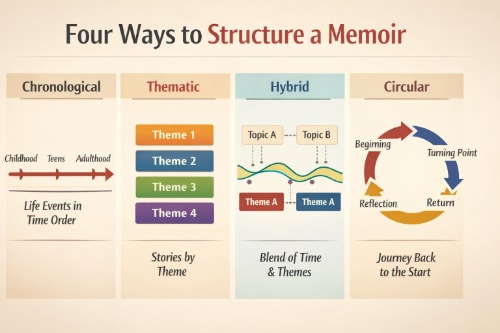
That is a life story told in order from the beginning to the current day. It includes childhood, important life stages, and moves to the present. It’s a life story with clear progression and transformation over time. It also meets the expectations of most readers.
This form of memoir is easy to follow. The story has a natural flow, and the structure is familiar. The downside to this form is that it can feel slow. The early chapters are often weak. Critical readers may mumble, “Hurry up and become an adult. I didn’t buy this to read about your toy train set.”
“And then this happened….” Poor structure leads to a loss of interest. Don’t bore the reader.
Thematic structure
The thematic memoir
What’s that? It’s a memoir organized by themes, not by time. Each chapter has its own distinct topic. A thematic memoir could devote a chapter or a “part” (with chapters within that part), on family, career, failure, identity, and more.
It’s a format that works well for someone who’s led a complex life and thus has a large number of story “threads.” This approach works best when the story isn’t defined by a strict timeline. Here’s an example of how that could work for a book:
-
- Chapter 1: A childhood moment.
- Chapter 2: The present-day situation.
- Chapter 3: Early career.
- Chapter 4: Back to childhood.
It’s a weaving together of seemingly disparate, but related, events. Done this way, the memoir can demonstrate cause and effect across time, and contrast past and present. The perspective for the reader is depth instead of sequences. Nobody says there’s a law that requires all memoirs follow a straight line. If the thread doesn’t connect to the central theme, then the reader could get lost.
This structure is flexible and allows deeper insight, while avoiding timeline drag. The downside is it can feel disjointed, and it requires strong transitions.
You’ve arrived at the point where many people realize structuring a memoir is more complex than they thought, which is one reason they turn to professional ghostwriting services for assistance. Two more memoir structures are coming up, beginning with:
The framed memoir (anchor event)
It’s built around one central event
The classic definition of “memoir” is exactly this. The story of one’s military service or profession, such as a flight attendant, banker, pilot or wood crafter. An autobiography is all-encompassing, such as one’s life story from the beginning to the present.
The “anchor” is the event, and the story is constructed around it. Examples would include:
• Illness and recovery.
• Legal or courtroom fight.
• Major decision.
• Crisis situation and its resolution.

A single defining event is something that demands attention and gives the story immediate weight. The memoir unfolds from that moment, with the past revealed through flashbacks. For example, The Year of Magical Thinking centers on the sudden death of Joan Didion’s husband, with memories and reflections branching outward from that loss. Similarly, When Breath Becomes Air is built around a terminal diagnosis, with earlier life experiences reframed in light of that reality.
This structure works because it creates immediate narrative tension. The reader knows something significant has happened and is drawn in to understand how and why. It also keeps the story focused; everything relates back to the central event. But that focus requires discipline.
It’s easy to drift into unrelated anecdotes or an extended backstory that weakens the frame. The writer must continually ask: Does this moment deepen the reader’s understanding of the central event? When handled well, this type of memoir is one of the most compelling structures available. It’s tight, emotionally resonant, and hard to put down.
Non-linear or mosaic
The jigsaw puzzle-style memoir
Are you a puzzle fan? Here’s one for you. The memoir structured in a non-sequential form. It requires the reader to be on their toes. There are jumps in time. You’re confronted with fragments of the story, individual scenes, and even moments.
Think of it like this: There is a painting, something entirely new to you, but only small sections are randomly revealed at any one time. Eventually, the image reveals itself as more covering sections are removed.
The emotional truth of the story will appear well before the timeline ends. It takes an experienced writer to assemble a story in this manner. It’s powerful when done well, as it mirrors how human memory functions.
The downside? It can be confusing if poorly executed. It’s certainly harder to structure, and not everyone will appreciate its artistic nature.
How to choose the right structure
Structure determines how your story is understood
Choosing the right memoir structure isn’t guesswork. The same applies when choosing who helps you write it. Here’s how to choose the right ghostwriter.
If your goal is clarity, use a chronological structure. It’s the most straightforward approach and the easiest for readers to follow. Events unfold in order, and the narrative builds naturally from beginning to end.
If your goal is insight, a thematic structure is more effective. It allows you to connect experiences across time and focus on meaning rather than sequence.
If your goal is tension, use a framed structure. Anchoring the story around a single event pulls the reader in immediately and gives everything else a clear point of reference.
If your goal is depth and complexity, a non-linear (jigsaw puzzle) structure works best. Multiple threads allow you to show how different parts of your life connect, but only if those connections are real and deliberate.
You can explore our ghostwriting video library for practical examples and explanations.
Most memoirs fail not because the story is weak, but because the structure doesn’t support it.
A memoir isn’t just what happened. It’s how you choose to tell it. And structure is where that decision begins.